Atabey
The word Atabey comes from the Taíno people, the indigenous people of the Caribbean. "Atabey" refers to a Taíno goddess associated with fertility, water, and the earth. She was often considered a maternal figure, and her role was seen as essential for creation and sustenance.
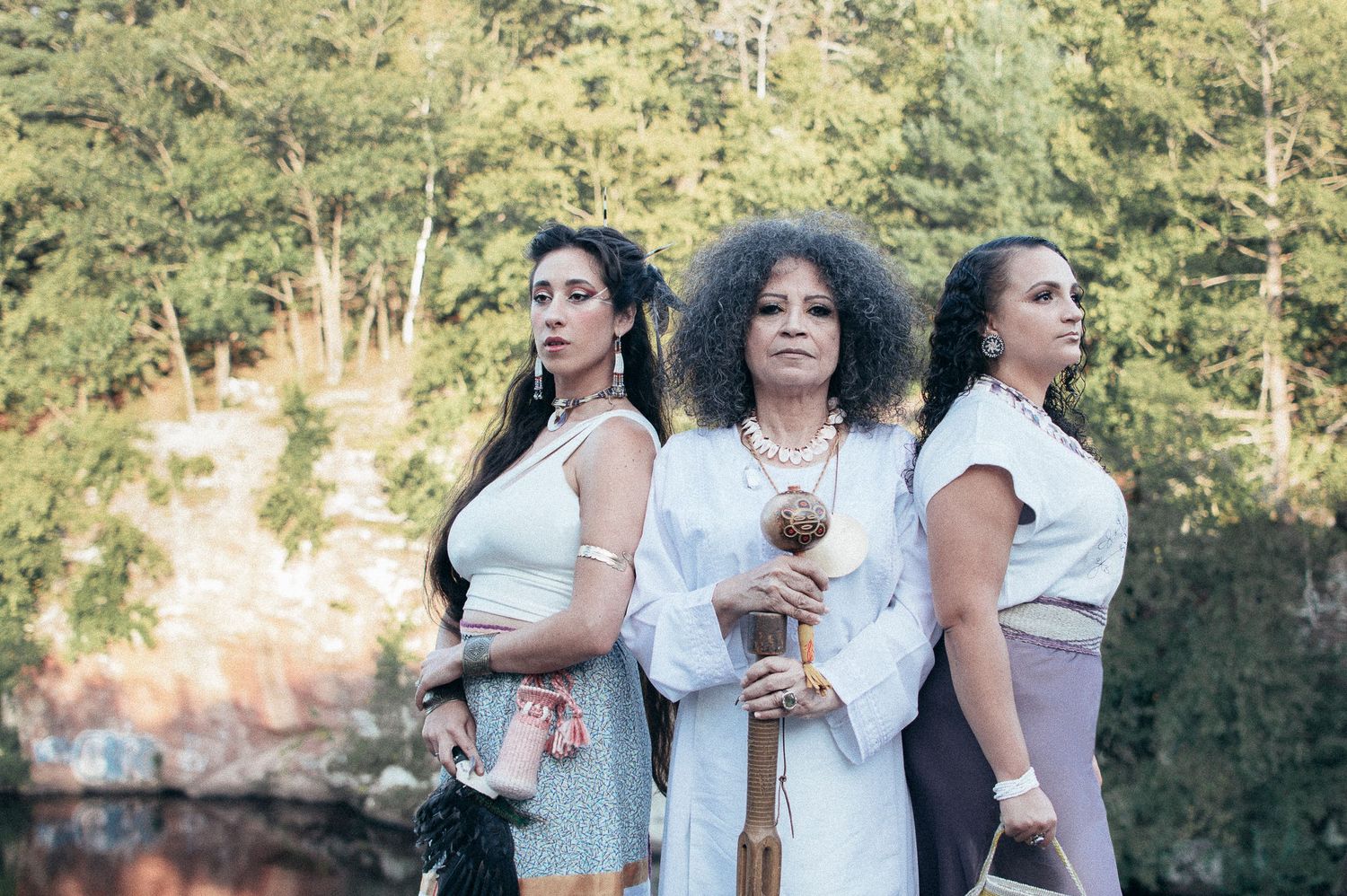
Atabey is a portrait series honoring three goddesses - women of Nipmuc and Afro-Taína descent. Created in collaboration with the women pictured, this work centers Indigenous presence, power, and connection to land. Alvilda, Brittney, & Jasmine, the featured women in this work are artists and activists whose creative & political work is rooted in community and making lasting change. This project is a tribute to Indigenous women whose voices and presence are too often ignored.
An image from the series will be installed as a photo mural in Indian Orchard, supported by Common Wealth Murals.


Motivations behind the work
“I wanted to honor the Taínos (Indigenous community from the Caribbean) but already felt off about taking up space in my previous mural work with there being very little representation in the public art world for the Indigenous nations in this region. I decided I wanted to create a mural that honored both (nations from the Caribbean & Western Mass area). Being from Puerto Rico, (a current colony of the US), I feel very strongly about cultural appropriation & displacement - and because of this it was important for me to find a Creative Co-Director from a local Indigenous community, (Jasmine is also Nipmuc), that would help lead/create the vision of the project in an authentic & respectful way, in addition to featuring Indigenous models that have made contributions to their communities.
During our creative process one of the models, Alvilda who is also a historian, uncovered that where I was called to do the photoshoot, has a tragic story behind it. Alvilda informed us that our photoshoot location had been an area where natives had been chased down by colonizers who were trying to murder them, and decided to jump down off the cliff into the water - the natives and their children died.
This mural is a way of reclaiming space, making people aware of this area’s history, but also a way of showing that there are still Indigenous communities out here and they’re thriving.”

Alvilda Sophia Anaya-Alegría
Alvilda Sophia Anaya- Alegría, is a Afro-Taína Fine Art and Urban Artist, Economist and a published nonfiction Historical Writer born in Guayama, Puerto Rico. Professor Anaya-Alegría has a Master’s of Science in Economics from Southern University of New Hampshire. Professor Anaya-Alegria has taught Economics and Finances, Statistics at Springfield College; Theater and Studio Art in Painting and Architecture at Cambridge College; English at UMass Amherst and Woman and Economic Development at Tufts University. Anaya-Alegría has received numerous Fine Arts awards and grants. The most recent is a 2022–24 a Mellon Foundation Arts juried exhibit award; 2016, The Fine Arts Work Center.
- Collective’s to support: Indigenous Peoples Day MA

Brittney Walley
Brittney Peauwe Wunnepog Walley, Nipmuc, interdisciplinary thinker, traditional weaver, and tribal activist. MS from UMB (2024), BA from RIC (2013). Her work encompasses cultural continuity, wellness through art, and illuminating histories that often go untold. Brittney’s art can be seen in a recently installed permanent exhibition that she co-curated at the Concord Museum (MA), and has previously been displayed throughout the northeast and even on the west coast. Her wearable art has been warmly received locally and internationally by both Native and non-Native people.
- Collective’s to support | MA Indigenous Legislative Agenda
- Statement necklaces by | Wampum Moon

Jasmine Rochelle Goodspeed
[She/They](Nipmuc) | Co-creative Director & Featured Model
Jasmine Rochelle Goodspeed, Creative Director, has been working within her community (the Hassanamisco Nipmuc People) since she was a child. As one of the founding members of the Ohketeau Cultural Center in Ashfield, Massachusetts, Goodspeed also works closely with surrounding Indigenous Nations and historical societies, hosting events throughout New England. As an actor, singer, director, and playwright, Goodspeed has extensive experience in productions focused on theatrical storytelling within the realm of historical truth telling. In 2018, Goodspeed wrote, produced, and acted in her musical "1675" at the University of Massachusetts Amherst, recounting the tragedy of Nipmuc, Wampanoag, and Massachusett Native people sent to Deer Island during King Philip’s War. From 2013-2017, Goodspeed produced “Free Shakespeare in the Park” at Northampton’s Look Park.
For the Plymouth 400 celebration, Goodspeed worked with the Wampanoag Nation and Theatre Royal Plymouth on a play concerning Indigenous History in Massachusetts. This production, titled "We Are The Land," told the story of colonization from an Indigenous perspective, bringing forward important markers of Massachusetts state history that were previously untold. From 2022 to 2023, Goodspeed worked with Historic Northampton and “Plays in Place” in a successful (sold out) series of place-based plays centered around Northampton history. She authored an original drama about one of the enslaved women – “Rose” – in Reverend Jonathan Edwards' household. She has also directed shows for the Pioneer Valley Performing Arts Charter School. Recently, Goodspeed worked as an Indigenous History Consultant for the town of Sudbury, Massachusetts, through the Goodnow Library’s “Indigenous History” initiative. Her historical research places her both with historical documents, and moving through Nipmuc lands to better understand the story of colonization.
- Collective’s to support: Ohketeau Cultural Center